I write from the island of Curaçao. It’s part of the Netherlands Antilles, otherwise known as the ABC islands in the Southern Caribbean. I spent a week in Aruba (the A in ABC) and then I hopped a small jet to Curaçao (the C).
Some refer to this 171 square mile dot in the ocean as “baseball island.” One hundred fifty thousand people live on the island, and there is a major league baseball player for every 21,000 inhabitants. For comparison, the Dominincan Republic, where I spent two months working for MLB at their unoffical Latin America headquarters, has one major leaguer per 125,000 residents. The United States meanwhile boasts one major leaguer for every 503,000.
This place is an odd, sunny, colonized crossroads located just 40 miles north of the Venezuelan coast. Many people think the island is part of Venezuela, so I startled a few adults and received a warnings before arriving here. It’s not Venezuela. Rather, it was a Dutch colony, and now it’s a constituent country of the Kingdom of the Netherlands.
After eight years of Spanish education, and the past three months in Spanish-speaking countries and territories, I am proud to say that I now, with some ease, stumble through Spanish conversation. While I approach bilingualism, most Curaçaoans are fluent in four languages: Papiamentu, Dutch, English, and Spanish. Some speak a fifth. Papiamentu is a Portuguese creole spoken by all permanent island inhabitants. While colonizing cultures often confine creole to the street and local inhabitants in a variety of Caribbean nations, Curaçao is one of the few places in the world in which a creole language plays a significant role in the colonized educational system. Papiamentu was not always incorporated into the Dutch curriculum. Rather, it was reinstituted into the schools in the Antilles in the 1980s, and since 1993, primary schools on the island use Papiamentu to teach literacy.
Since the moment I stepped off the plane, the multilingualism of this land adds tentative confusion to my lips. I constantly wonder whether to greet someone with “Que la que?” or “Wussup?” and I am not sure how one finally pops out. Though, because of overwhelming urge to separate myself U.S. tourists here, I find myself swaying away from using English.
“Did you just step off the [cruise] ship?” I am asked if I do initially speak to a stranger in English. On the other hand, if I begin in Spanish, once formalities are breached, and I say I am from California so begins an explanation of why I am speaking Spanish.
I say, “Es que ya pasé tres meses en la Republica Dominicana y Puerto Rico, por eso mi mente está en el modo de español.”
I am thinking seriously about my desire to distance myself from U.S. tourists and culture. If I speak in Spanish to new aquaintences, they often ask if I am from Brazil or Mexico, and it could simply be my subjective reality, but I feel as if I am treated more warmly than if I begin in English. If I begin in English, people assume I come from a cruise ship, or am staying at a resort, and thus begins my uphill battle to attempt to explain, that yes, I, a woman, am here alone, not in a tourist capacity, but rather as a researcher conducting a year-long investigation into international baseball.
Once I do conjure the courage to approach a stranger, my questions and hesitancy about whether to make English or Spanish sounding noises and about what type or response each will yield often leaves me filled with an outlandish wonder of where in the world I am. I’ve never stood without a clue of what language to speak to someone. This new feeling sometimes leaves me silent, without the will to breach a new dialogue. Though, for example, once Cedric Boekhoudt and I established the formalities, in which we speak mostly English, with Spanish thrown in, and I attempt to follow some of his Papiamentu, the sparked discourse flows differently than a conversation confined to language or culture. Our jumps between languages, cultures, and misunderstandings, and the constant wonder we hold and apply to whether or not we understand one another has led to deeper interpersonal understanding than I found in the Dominican Republic or Puerto Rico. In D.R. and P.R., apart from the latin greeting of a kiss on the cheek, friends, coworkers, and strangers would often immediately speak English with me or ask me what I thought about Donald Trump’s campaign. Here, on this tiny island influenced by but not limited to Dutch, Latin, African, and American culture, my interactions move more slowly towards U.S.-centric questions about the 2016 presidential election or MLB’s ability to immediately halt World Series play two weeks ago when Fox’s broadcasting vehicle lost power.
In contrast to countries and territories I have visited thus far, MLB plays a tiny role in organizing and supporting baseball on this small Caribbean island. In both Puerto Rico and specifically the Dominican Republic, MLB provides infrastructure in Academies and player development and organization in summer leagues. Here on Curaçao, with MLB and other American companies influencing the culture to a lesser extent, my interactions with Cedric, his son Mani, and other organizers of Curaçao’s amateur baseball leagues, operate within cultures that are foreign to me. I am therefore willing to say that I finally feel far from home.
I end this post with a small anecdote that illustrates the size of this island. It is my hope that this post will serve as a spark for a few rapid-fire blog posts in the coming week. The work of processing, understanding, and putting words to my experiences does not roar along at the speed at which the internet moves and our world now operates.
As I was saying, this rock in the sea is tiny. That became clear when I was scorekeeping for a Senior League game between the Royal Scorpions and Santa Rosa Ennia on Saturday night at Tio Daou, and Cedric bumbled up to me with a “Bon noche!”
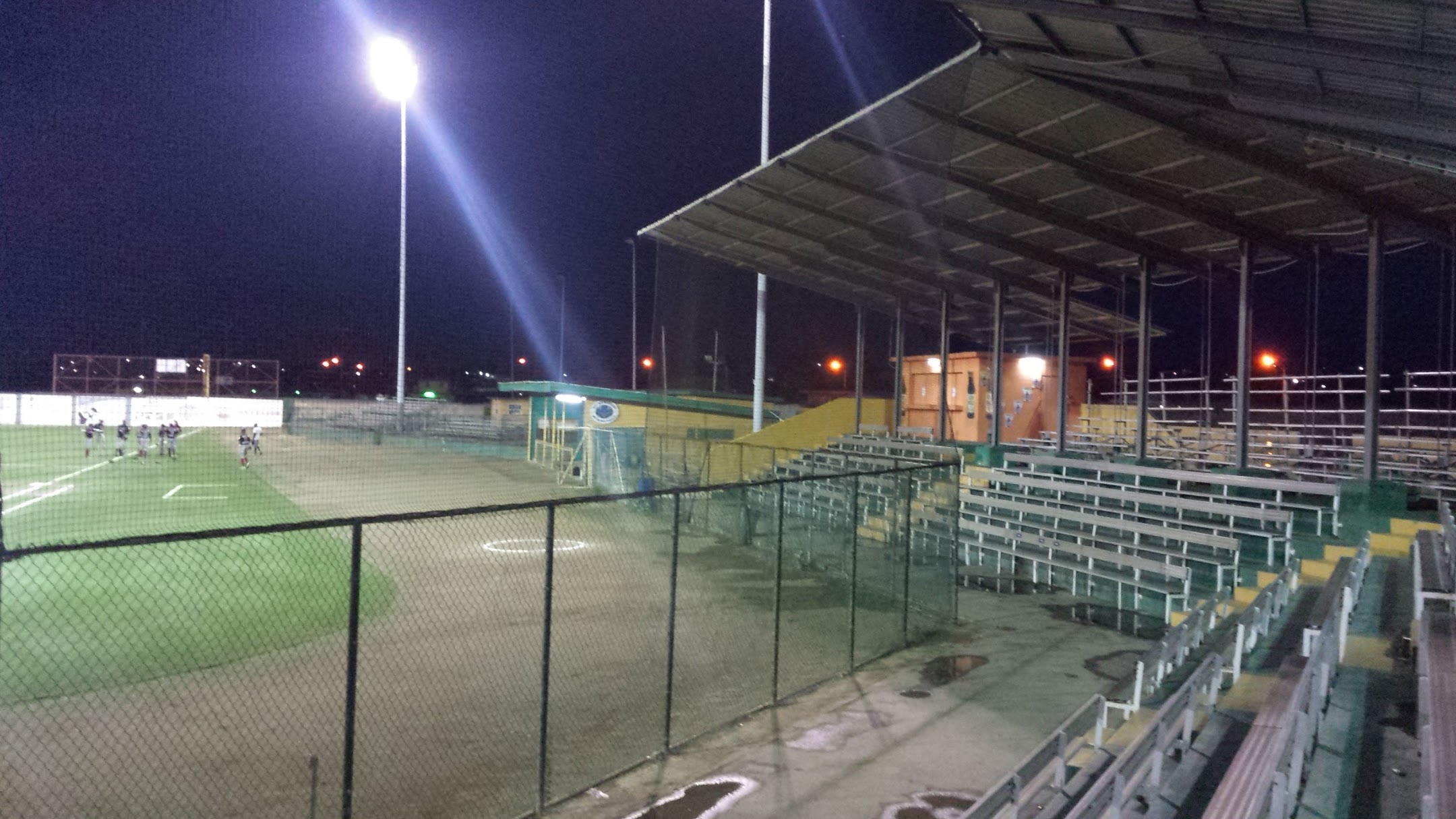
Santa Rosa, Curaçao
I am staying at a hostel here, and Annabel, a guest at the hostel, goes to church in Utrecht, Holland, with a cousin of Cedric. Thus, Annabel put me in touch with Cedric, and as the world runs on What’s App, I sent him a message. He read it, and moments later his phone broke. He had intended to help socialize me to baseball on the island, but he now had a broken phone and wondered if and when he would get back to me. Then, at Tio Daou on Sunday, he saw a young woman quietly keeping score and watching the game alone. He asked a few friends, “Do you know that girl?” And when no one at the stadium knew me, he walked up to me, with a “Bon noche, are you Emily?,” Cedric has since catalyzed my research on this island.
I have now met the MLB scouts for the Boston Red Sox, Cincinnatti Reds, Texas Rangers, and New York Mets, that live and work on the island. I participated in a training with professionally signed players yesterday (read: I played catch with the 10-year-old that attended the training). And, today, I will help Cedric and Elmer, two youth coaches, run a practice for eight and nine year old boys.
 Reconciling with the Diamond (A Girl's Best Friend)
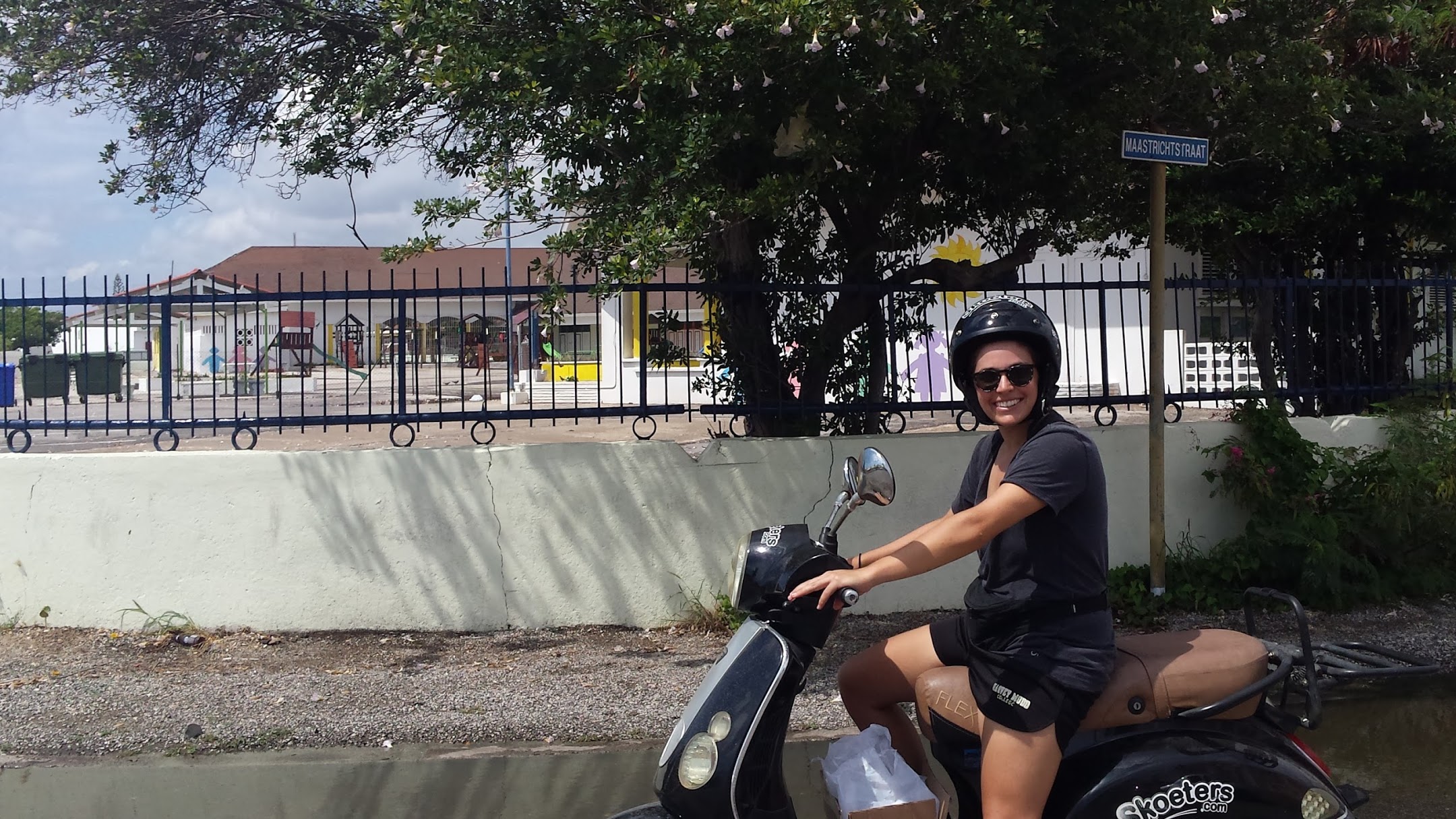
This is GREAT! This is exciting! I love the scooter. You are a Watson ROCK STAR! Keep the missives coming. (as for baseball news here, I can reveal that Mark McGwire’s younger brother nows works out and works as a trainer at my gym. He was the guy who gave Mark the steroid precursors back in the day. He went on to write a tell-all book about it.)
LikeLike
John! Do you mean Jeremy McGwire or another little brother? Also, I know a few Johns! Will you clarify your last name?
LikeLike
No, Jay McGwire (see here: http://sports.espn.go.com/espn/otl/news/story?id=4941099) plus, I’m a prof at Pomona in the politics department.
LikeLike
You are the best!
xxMomxx
LikeLike
I like the new ride. When will we chat? Susie answered our All Saints question.
Doc
LikeLike
Really cool, Emily, thanks for keeping us up to date on your discoveries. Check in with the Curacao Little League folks – they’re always dominant and it would be interesting to see what they do/don’t differently instruction-wise compared to the US. Also are hot dogs and snow-cones as vital a part of youth baseball…
LikeLike
Well, Emily, though we have yet to meet, I hear so much about you from your Aunt Marian, and I have been following your travels around the world. Thank you for helping us travel vicariously! It feels like something has shifted in you, like a ship that has left the harbor and the bay, and is now sailing freely in open waters. You are meeting new people, hearing new languages, and immersing yourself in cultures other than your own. It is truly a transforming experience, and to me, it is the best one a young woman could have: no formal schooling could ever give you that. Best of luck to you, and congratulations!
LikeLike
Emily,
This is so cool! I have never been to Curacao but have visited Aruba twice; my uncle worked there for Esso for 30 years. I was thrilled when Andruw Jones joined the Braves. (He was billed then as from Aruba, but now they have him growing up in Curacao.) Besides Papiamentu, Aruba had something else to commend it to an impressionable Midwesterner like me: no fresh water. All the water drunk on Aruba either falls from the sky or, in modern times, is filtered from the sea. I am amazingly impressed by people who lived there for centuries scavenging not only for food but for water. And Arnie and I are both amazingly impressed by your continued boldness in pursuing your dream. Rock on! – Susan
LikeLike
🙂
LikeLike